Front Door Feng Shui
Feng Shui Front Door Direction: What Actually Matters
Feng Shui front door direction explained through environmental psychology, light exposure, and easy renter-friendly design shifts for a tidier entryway.
The ModernQiHome Editorial Team researches and writes home wellness and modern Feng Shui guidance for Western homes, grounded in Eight Mansions (Ba Zhai) space theory and interior design fundamentals — every guide is written and fact-checked as a team process, not a single freelance byline.
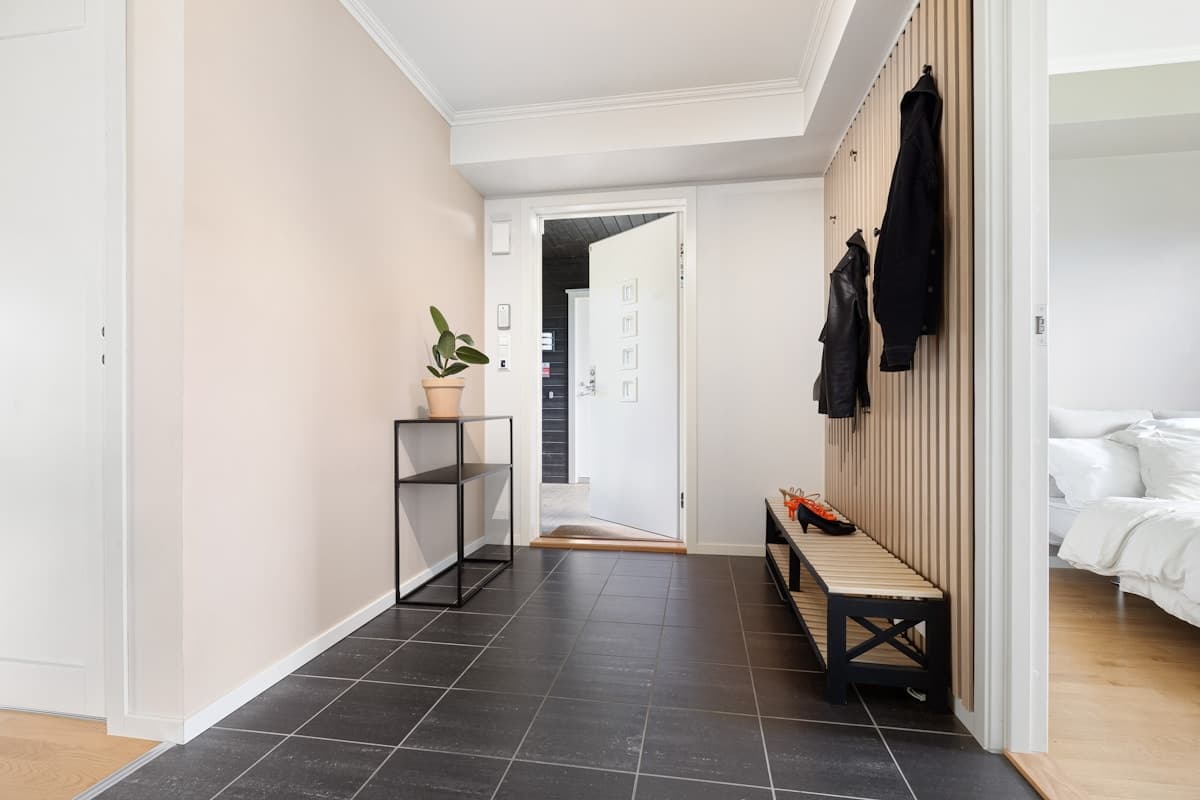
Why front door direction gets so much attention in Feng Shui
In traditional Feng Shui, the front door is often called the "mouth of chi," the main point where energy, light, and fresh air enter a home. In more modern, Western terms, this idea overlaps with something environmental psychologists actually study: entryways shape our first sensory impression of a space, and that impression can influence how relaxed or alert we feel the moment we step inside.
Direction matters in classical Feng Shui because it connects to your personal Kua number, a calculation based on birth year and gender that identifies which compass directions tend to feel most supportive for you. But direction is only part of the story. What actually matters day to day is how the entrance functions: how much light it gets, how clear the pathway is, and how safe and welcoming the space feels the second you walk through it.
What direction can tell you (and what it can't)
If you've calculated your Kua number and compared it to the East Group vs. West Group system, you may already know whether your front door leans toward your supportive directions or not. This can be a useful reference point, similar to knowing your chronotype or your home's natural light pattern.
However, direction alone doesn't determine how a space feels to live in. A south-facing door with strong afternoon glare and no shade can feel harsh, while a north-facing door with warm lighting, a clear pathway, and thoughtful color choices can feel grounded and welcoming. In modern design terms, direction is a data point, not a verdict. It's most useful when you use it to fine-tune small design choices rather than as a fixed rule.
The mechanisms behind common front door guidelines
Here are a few frequently mentioned Feng Shui guidelines, translated into design and psychology terms you can actually work with.
1. A clear, unobstructed entry path
Feng Shui often recommends keeping the path to your front door open and unblocked. In environmental psychology, this connects to something called "prospect and refuge" theory: humans feel more at ease when they can see a clear way in and out of a space. Clutter, bikes, or overgrown plants near the entry can create a subtle sense of friction before you've even opened the door.
Renter-friendly action: Clear a simple, direct walking path to your door and keep it lit at night with a plug-in or solar light. No permanent changes required.
2. Good lighting at the entrance
Many Feng Shui traditions favor a well-lit front door. This lines up with basic safety psychology and circadian light research: bright, even lighting at entry points helps your nervous system register a space as safe, while dim or flickering light can trigger low-grade alertness.
Renter-friendly action: Add a warm-toned LED bulb or a battery-powered sconce near the door. This is fully reversible and takes minutes to install or remove.
3. A door that opens fully, without obstruction
A front door that only opens partway (blocked by furniture, shoes, or a narrow hallway) is sometimes discouraged in Feng Shui because it's said to restrict incoming energy. In modern terms, a door that doesn't open completely creates a small daily inconvenience and a subtle visual cue of restriction every time you enter.
Renter-friendly action: Rearrange furniture or shoe storage so the door swings fully open. Use slim, wall-mounted racks instead of freestanding ones if space is tight.
4. Color and material choices aligned with direction
If your door faces a direction associated with the Water element, deeper blues or black accents are sometimes recommended; if it faces a Fire-associated direction, warmer reds or oranges may be suggested. This isn't about literal energy, but about color psychology: certain tones can feel more harmonious against certain amounts of natural light. A very warm-lit south entry may look better with cooler, muted tones instead of another layer of warmth, for example.
Renter-friendly action: Test with a removable door mat, a temporary wreath, or peel-and-stick accents in a shade you like before committing to paint (always check your lease first).
How to actually check your door's direction
1. Open a compass app on your phone (built into most iPhones and available as a free download on Android).
2. Stand directly in your doorway, facing outward, away from your home.
3. Hold the phone flat and read the direction your body is facing, that's your door's compass orientation.
4. Round to the nearest of the eight main directions (N, NE, E, SE, S, SW, W, NW) rather than obsessing over an exact degree reading.
This takes under a minute and gives you enough precision for every fix in this guide.
Using your Kua number as a starting point, not a rulebook
If you want to go a layer deeper, your personal Kua number can help you understand which directions are traditionally considered supportive for you specifically. For example, guidance associated with a Kua number 4 profile may differ from someone with a different number, even in the same home. This is similar to how two people can live in the same house but have very different preferences for light, layout, or color.
The goal isn't to move your front door or panic about its orientation. Instead, use your Kua number as a lens: if your entry direction happens to align with your supportive directions, treat that as a small bonus. If it doesn't, focus your energy on the parts of the entryway you can actually control, like light, clutter, and color, which tend to have a more immediate, tangible effect on how the space feels.
A simple, modern entryway checklist
- Clear the walking path to your door
- Add warm, reliable lighting
- Make sure the door opens fully
- Choose colors and textures that suit your natural light
- Use your Kua number as a helpful reference, not a strict requirement
A front door doesn't need to face a specific compass point to feel good to walk through. Small, reversible design choices, layered with a little personal insight from your Kua number, tend to make a bigger daily difference than direction alone.
FAQ
Does my front door direction really affect my life outcomes?
ModernQiHome treats direction as a design data point rather than a guarantee. Factors like light, clutter, and pathway clarity tend to have a more immediate, tangible effect on how an entryway feels day to day.
What if my front door faces a direction that isn't considered supportive for my Kua Number?
Treat it as one input rather than a problem to fix. Focus your effort on the parts of the entryway you can control, like lighting and clutter, which matter more for daily experience than compass alignment alone.
How do I find out what direction my front door is?
A compass app on your phone, held flush against the outside of your door while facing away from your home, will give you an accurate reading in seconds.
Do I need an exact compass degree, or is a general direction good enough?
A general direction (one of the eight main compass points) is enough for every fix in this guide. You don't need precision beyond that for practical design decisions.
What if my apartment's front door is actually inside a shared building hallway?
Use the direction your unit's own door faces, not the building's main entrance. Your daily interaction is with your specific door, so that's the direction that matters for these fixes.
This article is intended as cultural appreciation and interior design inspiration, offered for personal reflection rather than as a guarantee of any financial, health, relationship, or professional outcome.
If you'd like to see how your own birth details translate into supportive directions for your front door and beyond, the free Kua Number Calculator is a simple next step.
You might also like
East Group vs. West Group Feng Shui: What It Means for Your Kua Number
East Group and West Group Feng Shui explained: which Kua Numbers belong to each group, their supportive directions, and how to use this at home.
What Is a Kua Number? A Modern Feng Shui Explainer
What is a Kua Number, how it's calculated from birth year and gender, and how to use it as modern Feng Shui guidance at home.
Next step
Curious how your personal direction fits your entryway? Try the free Kua Number Calculator to find your supportive directions in minutes.
Try the free calculator