Home Wellness Psychology
Does Feng Shui Actually Work? What the Research Says
Is Feng Shui real, or just superstition? A clear-eyed look at which Feng Shui principles line up with environmental psychology and sleep research, and which don't.
The ModernQiHome Editorial Team researches and writes home wellness and modern Feng Shui guidance for Western homes, grounded in Eight Mansions (Ba Zhai) space theory and interior design fundamentals — every guide is written and fact-checked as a team process, not a single freelance byline.
The honest answer: partly, and here's specifically where
Feng Shui isn't a scientific discipline, and no credible source should claim it is. But that's a different question from whether its individual recommendations do anything. Several core Feng Shui principles line up closely with established findings in environmental psychology, sleep science, and attention research — not because ancient practitioners had lab equipment, but because careful, repeated observation of what makes a space feel good tends to converge on similar conclusions however you arrive at them. Other Feng Shui claims (like specific numbers of fish in a tank affecting your career, or a mirror inviting "third-party energy" into a relationship) have no independent evidence behind them at all. This article separates the two.
What lines up with real research
The commanding position and prospect-refuge theory
Feng Shui's most consistent bedroom and desk rule is the "commanding position": placing your bed or desk so you can see the door without being directly in line with it. This maps closely onto prospect-refuge theory, a well-established idea in environmental psychology (first proposed by geographer Jay Appleton) that humans instinctively prefer spaces offering a clear view out ("prospect") combined with a sense of enclosure and protection ("refuge"). A bed facing away from the door, or wedged in a blind corner, denies both, which is consistently associated with lower reported feelings of security in space-perception research. See our bed placement guide for how to apply this even in a small studio.
Clutter and cognitive load
Feng Shui describes clutter as "stagnant chi" blocking energy flow. Attention research describes something functionally similar: every object in your visual field competes for a small amount of processing capacity, a phenomenon studied under biased competition theory in visual attention research. A cluttered counter isn't just untidy — it's asking your brain to do continuous low-level filtering work, which contributes to the general phenomenon researchers call cognitive load. See our decluttering guide for a room-by-room starting plan grounded in this idea.
Natural light, plants, and materials
Feng Shui strongly favors natural light, live plants, and natural materials like wood over synthetic ones. This overlaps closely with biophilic design, a well-documented design framework built on the biophilia hypothesis — the idea that humans have an innate affinity for natural elements, and that incorporating them into built environments measurably supports mood and reduces stress markers. Feng Shui's preference for plants, natural wood tones, and daylight isn't a coincidence; it's the same underlying human preference, described in a different vocabulary centuries earlier.
Mirrors, light, and sleep disruption
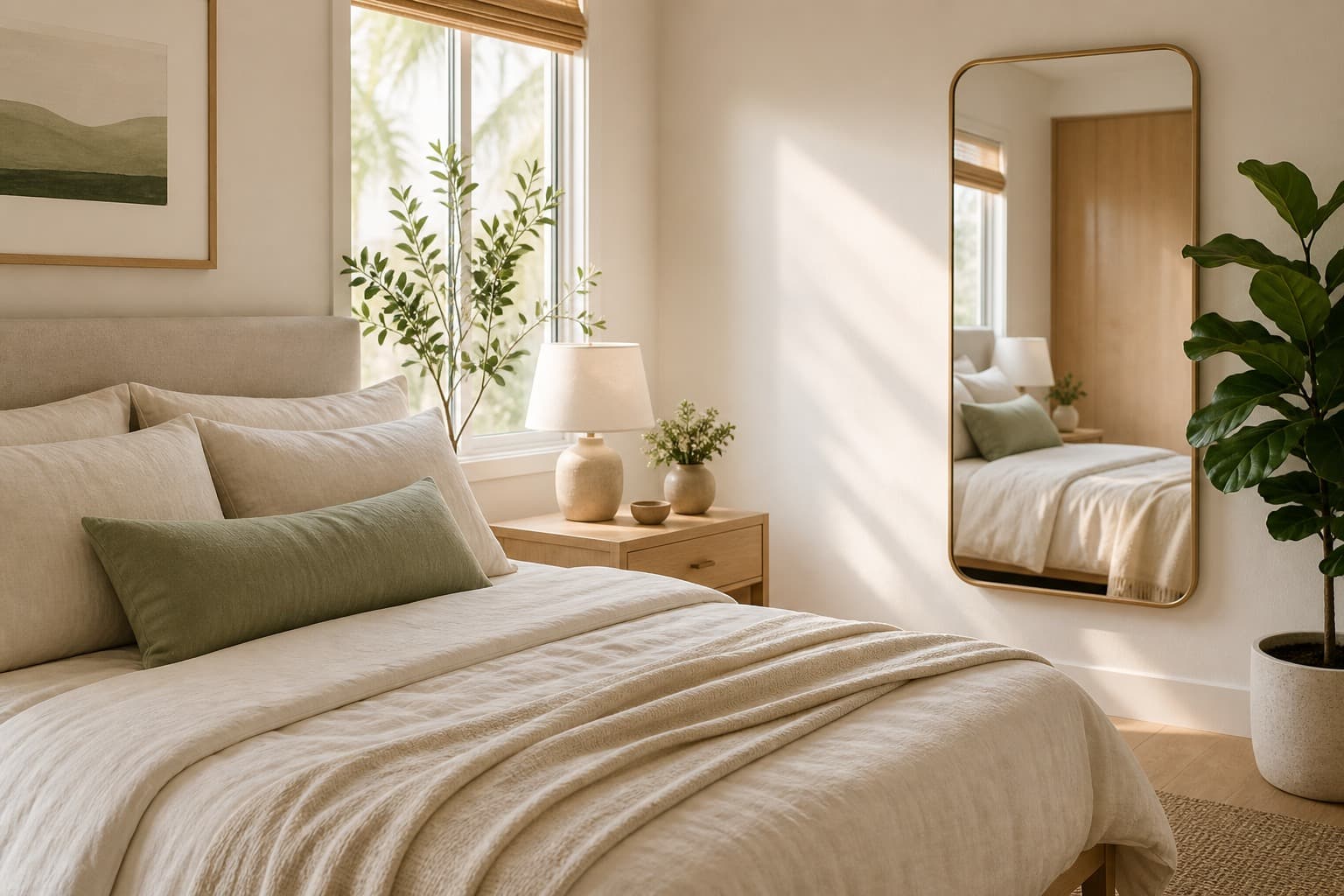
The Feng Shui caution against a mirror facing the bed has a genuine sleep-hygiene overlap: mirrors reflect ambient light and movement, and both are established disruptors of the wind-down process before sleep. Whether or not you find the "energy amplifier" framing compelling, the practical fix (repositioning or softening a bedroom mirror) is the same one a sleep-hygiene checklist would recommend. Full breakdown in our mirror-facing-bed guide.
What doesn't have independent evidence
- Specific numbers tied to luck (e.g., a fixed number of fish or coins being auspicious) have no basis outside the symbolic tradition itself. They're culturally meaningful, but not something research on well-being or outcomes supports or refutes directly.
- Direct causal claims about wealth or romance ("this cures poor financial luck") go beyond what any space-psychology research can support. A well-organized, well-lit workspace may support better focus and follow-through, which can indirectly support your goals — but no layout change causes a raise or a relationship on its own.
- Astrological/calendar-based claims (certain years or dates being universally lucky or unlucky) are cultural and historical in origin, not empirically testable in the way a room layout is.
What this means practically
The most defensible way to use Feng Shui in a Western home is as a layout heuristic backed by plausible mechanisms, not a set of guaranteed outcomes. When a Feng Shui rule has an environmental-psychology or sleep-science equivalent — commanding position, decluttering, natural light, mirror placement — it's worth taking seriously and testing in your own space. When a rule is purely symbolic or luck-based, it's fine to enjoy as cultural tradition, but it shouldn't carry the same weight in your decision-making.
This is also why every guide on this site pairs the traditional explanation with a plain-language mechanism, and why we never frame a layout choice as a guaranteed fix. If a change doesn't measurably improve how a space feels for you after a few weeks, it's fine to change it back — nothing here is meant to be permanent or prescriptive.
FAQ
Is there a single Feng Shui rule with the strongest evidence behind it?
Bed and desk placement using the commanding position is arguably the best-supported, since it maps directly onto prospect-refuge theory, a well-established concept in environmental psychology independent of Feng Shui itself.
Why do some Feng Shui claims have no scientific backing at all?
Many symbolic elements (specific lucky numbers, animal-year associations, certain colors as universal luck-bringers) originate from Chinese astrology and cultural symbolism rather than observations about physical space, so they aren't the kind of claim that space-psychology or sleep research can test.
Does that mean I should ignore the symbolic parts of Feng Shui entirely?
Not necessarily. Cultural and symbolic practices can still hold real personal or aesthetic meaning even without empirical backing — the distinction in this article is about which claims to weigh heavily in practical decisions versus which to enjoy as tradition.
Can Feng Shui replace actual treatment for sleep problems, anxiety, or other health concerns?
No. Feng Shui layout changes may support a more comfortable environment, but they are not a substitute for medical or mental health care. If you're dealing with a persistent health concern, a home layout change should be a complement to professional guidance, not a replacement for it.
This article is offered as cultural appreciation and interior design inspiration, not a guarantee of financial, health, relationship, or professional outcomes, and is not a substitute for professional medical or mental health advice.
You might also like
What Is Feng Shui? A Modern Guide for Western Homes
What is Feng Shui and how does it actually work? A clear, jargon-light explainer for Western readers, translating chi, yin-yang, and the five elements into home design terms.
Feng Shui Bagua Map Explained (No Overwhelm)
Confused by the feng shui bagua map? Here's a simple, modern breakdown of the nine zones and how to apply them without redesigning your whole home.
Feng Shui Decluttering for Small Apartments: Start Here
Feng shui decluttering doesn't mean a weekend purge. Learn where to start this week in small apartments, rentals, and shared rooms, one zone at a time.
Next step
Want a layout starting point backed by both tradition and your own birth data? Try the free Kua Number Calculator.
Try the free calculator