Bedroom Feng Shui
Feng Shui Bed Placement: The Complete Modern Guide
Learn feng shui bed placement through sleep science and space psychology, with renter-friendly tips for the command position, headboards, and more.
The ModernQiHome Editorial Team researches and writes home wellness and modern Feng Shui guidance for Western homes, grounded in Eight Mansions (Ba Zhai) space theory and interior design fundamentals — every guide is written and fact-checked as a team process, not a single freelance byline.
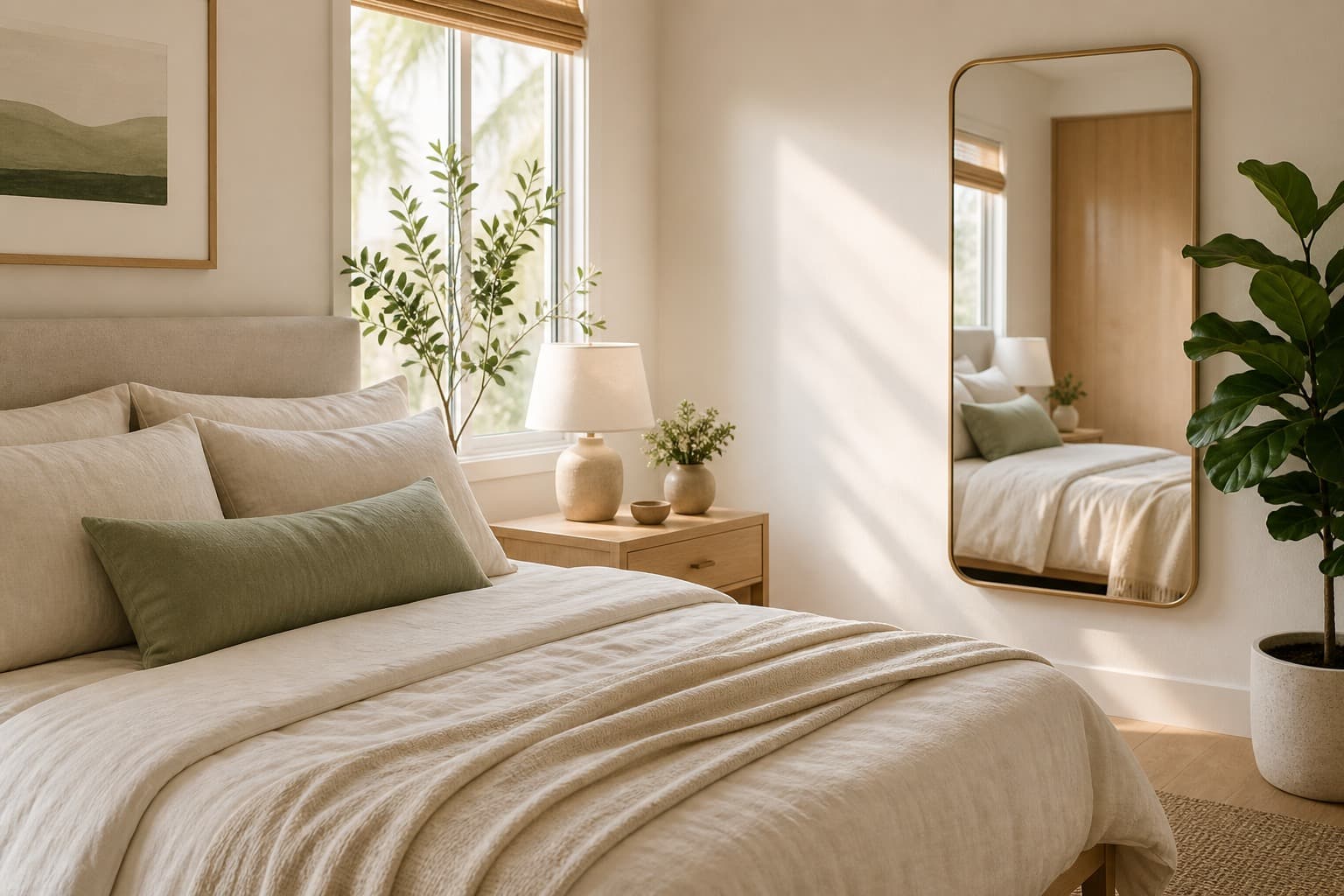
- 1Upholstered headboard against a solid wall, the bed's anchor
- 2Nightstand and lamp within arm's reach of the pillow
- 3Window beside the headboard, light softened by a woven shade
- 4Full-length mirror on the side wall, and it reflects the bed
Why bed placement shapes how you sleep
Feng Shui has long treated the bed as the most important object in the home, since so many hours of vulnerability and rest happen there. Modern sleep science actually supports part of this instinct: your nervous system relaxes more easily when it doesn't have to subconsciously monitor entry points, movement, or open sightlines while you sleep.
This is the real mechanism behind most bed placement guidelines. It isn't about attracting good fortune, it's about reducing low-level environmental alertness so your body can shift into deeper rest. Below is a modern, renter-friendly breakdown of the classic rules, explained through sleep psychology and interior design logic rather than superstition.
The command position, explained through visual field theory
The most repeated Feng Shui bed rule is the "command position": placing the bed so you can see the door from bed, without being directly in line with it, and ideally with solid wall behind the headboard.
Environmental psychologists describe a similar concept called prospect-refuge theory. Humans tend to feel safer in spaces where they have a clear view of the entry (prospect) while also having a solid boundary behind them (refuge). A bed tucked in a corner with a full sightline to the door checks both boxes automatically.
Renter-friendly ways to apply this:
- Angle the bed diagonally across from the door if your room allows it
- Choose a wall with no windows directly behind the headboard, if possible
- If your layout forces the bed in line with the door, add a soft footboard, bench, or runner rug as a visual buffer
None of these require permanent changes, which makes this one of the easiest updates for apartments and shared housing.
Why a solid headboard supports better sleep
A freestanding or missing headboard means your head is technically unsupported at the top of the bed, which can create subtle instability, both physically and visually. A solid headboard against a wall gives your sleeping brain a consistent, stable edge to reference, similar to how architects use grounded ceilings and low lighting to make a room feel enclosed and safe rather than exposed.
If you're renting and can't drill into walls, look for:
- A freestanding upholstered or wood headboard that leans against the wall
- A tall woven or rattan headboard, which adds texture without needing hardware
- Removable wall panels or fabric backdrops for a temporary solid-wall effect
Avoiding the direct line between bed and door
In classical Feng Shui, this is sometimes called the "coffin position," but the modern, non-alarming explanation is simpler: a bed placed in a straight line with the door puts you in the direct path of foot traffic, drafts, hallway light, and sound. From a sleep hygiene perspective, this can mean more light disruption and a higher chance of being startled awake.
If moving the bed isn't possible in a small room, try:
- A door draft stopper to reduce airflow and light leakage
- Blackout curtains or a room divider to soften the sightline
- A rug or bench at the foot of the bed to interrupt the direct visual path
Under the window: comfort versus exposure
Placing a bed directly under a window is common in small apartments, but it can affect sleep in two ways: temperature fluctuation near glass, and a feeling of being more exposed to outside movement and light. If your layout leaves no other option, this doesn't need a full furniture rearrange.
Simple fixes include:
- Adding a fitted headboard cushion against the window wall for insulation
- Using thermal curtains to reduce temperature swings
- Adding a small reading lamp nearby, which studies on room lighting suggest can offset the psychological "bareness" of a window-facing setup
Mirrors and the bed: a quick note
Mirrors facing the bed are one of the most talked-about Feng Shui details, largely because a mirror can visually double the room and create subtle movement in your peripheral vision at night. For a full breakdown of renter-friendly remedies, see our guide on mirror facing bed remedies.
Symmetry and equal access
Classical Feng Shui often recommends nightstands on both sides of the bed, even for a single sleeper. Design psychology offers a clear explanation here: symmetrical furniture arrangements are processed by the brain as more stable and orderly, which can lower visual "noise" in a room you're trying to relax in.
Easy renter-friendly version:
- Two small matching nightstands, even inexpensive ones, create this balance
- If space is tight, a pair of wall-mounted shelves can mimic the same effect
- Keep both sides at least partially clear of clutter for the least cluttered visual field
Choosing a supportive wall using your Kua direction
Beyond the general rules above, classical Feng Shui also maps supportive directions to your personal Kua number, which is based on birth year and gender. This is where bed placement becomes more personalized rather than one-size-fits-all.
For example, some people prefer a headboard facing east or southeast, while others align better with west-facing layouts. You can explore how these groupings work in our guide to east group vs west group Feng Shui, and learn the basics of the number itself in what is a Kua number.
If you already know your number, you can browse specific pages for it, such as Kua Number 1, Kua Number 4, or Kua Number 8, for direction-specific inspiration.
Quick-reference: problem to fix
| Problem | Fastest fix |
|---|---|
| No command position | Angle bed diagonally from the door |
| No headboard / unstable backing | Freestanding upholstered or woven headboard |
| In line with the door | Footboard, bench, or rug to break the sightline |
| Under a window | Thermal curtains, headboard cushion for insulation |
| Mirror facing the bed | Angle away, or soften with a curtain at night |
| Asymmetric nightstands | Add a matching pair, even inexpensive ones |
A simple modern checklist
Before you rearrange anything, walk through these questions:
- Can I see the door from bed without lying directly in line with it?
- Is there a solid wall or sturdy headboard behind me?
- Is a mirror reflecting the bed directly?
- Do both sides of the bed feel visually balanced?
- Is the room too bright, drafty, or noisy near the current placement?
Answering these honestly will usually tell you more than any single rule on its own.
FAQ
What if my room layout makes the command position impossible?
A full command position isn't always achievable in small or oddly shaped rooms. Partial fixes, like adding a footboard as a visual buffer or a small mirror to reflect the doorway, can offset most of the same effect without moving the bed.
Is it bad to sleep with your feet facing the door?
This detail matters less than overall sightline and support. Focus first on whether you can see the door without lying directly in its path and whether your head has solid support behind it.
Do I need a headboard for good feng shui bed placement?
A headboard helps by giving your head a stable, grounded reference point, but a freestanding or leaning headboard works just as well as a mounted one, which makes this renter-friendly.
Which single fix should I try first if I can only do one thing?
Achieving the command position, seeing the door without lying directly in line with it, tends to have the most noticeable effect relative to the effort involved, since it addresses the core sense of safety this whole guide is built around.
Can I combine several of these fixes at once, or should I test them one at a time?
Either approach works, but testing one change at a time for a week makes it easier to notice which specific adjustment actually improved how you sleep, rather than changing everything simultaneously and not knowing what helped.
This guide is offered as interior design inspiration and cultural appreciation of Feng Shui traditions, meant for personal reflection rather than a guarantee of health, sleep, or any other outcome.
If you'd like a more personalized starting point, the free Kua Number Calculator can help you map which wall directions may feel most supportive for your bed before you start moving furniture.
You might also like
Mirror Facing Bed? 5 Simple Feng Shui Remedies for Better Sleep
Modern Feng Shui remedies for a mirror facing the bed, explained through sleep, safety, and space psychology.
What Is a Kua Number? A Modern Feng Shui Explainer
What is a Kua Number, how it's calculated from birth year and gender, and how to use it as modern Feng Shui guidance at home.
East Group vs. West Group Feng Shui: What It Means for Your Kua Number
East Group and West Group Feng Shui explained: which Kua Numbers belong to each group, their supportive directions, and how to use this at home.
Next step
Curious which wall direction might feel most supportive for your bed? Try the free Kua Number Calculator to map your personal directions before you rearrange.
Try the free calculator