Bedroom Feng Shui
Feng Shui Headboard Guide: Material, Shape & Placement
A modern feng shui headboard guide covering material, shape, and placement, explained through sleep science and renter-friendly bedroom fixes.
The ModernQiHome Editorial Team researches and writes home wellness and modern Feng Shui guidance for Western homes, grounded in Eight Mansions (Ba Zhai) space theory and interior design fundamentals — every guide is written and fact-checked as a team process, not a single freelance byline.
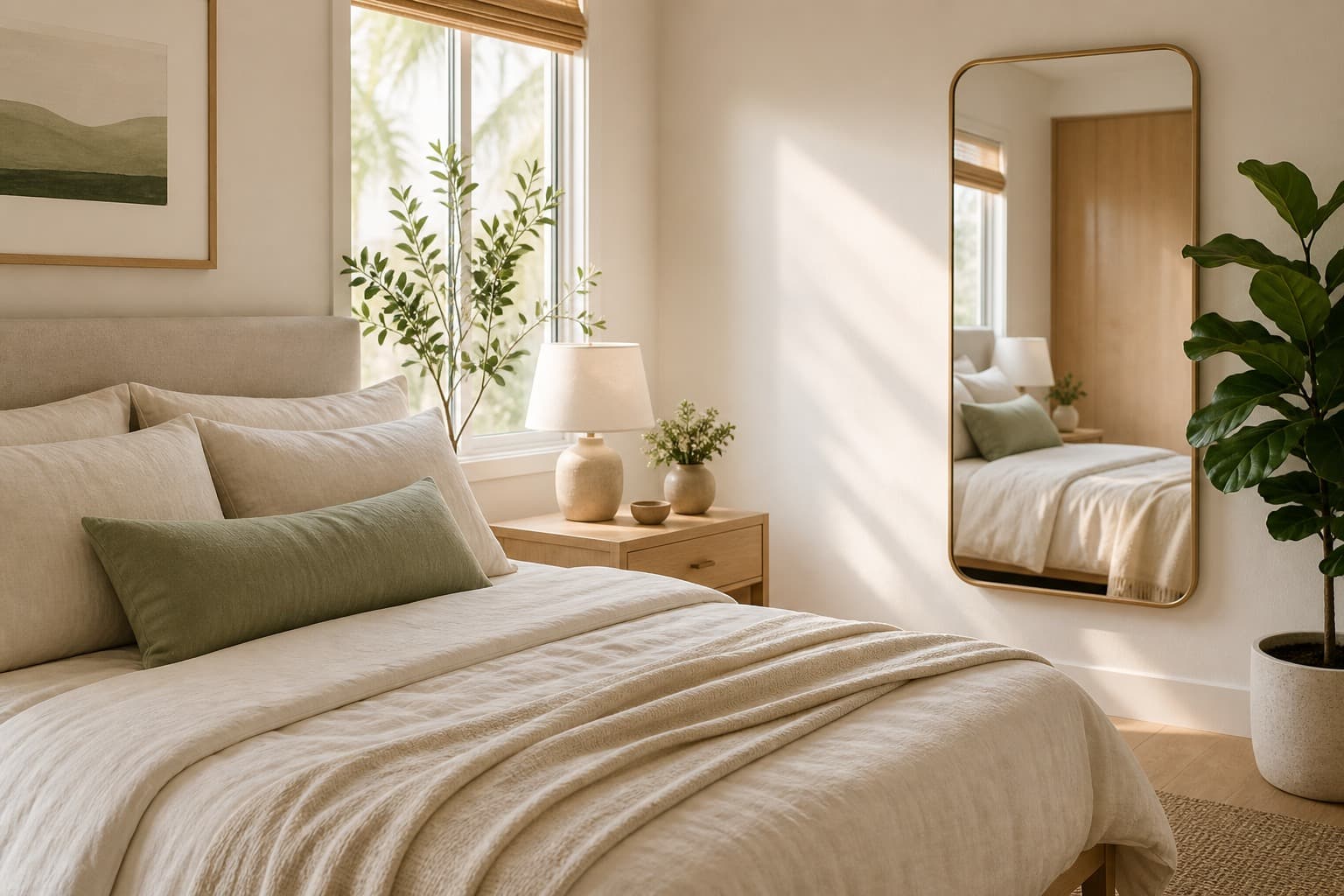
Why the headboard matters more than you think
In Feng Shui, the headboard is considered an extension of the bed's support system, the thing that literally has your back while you sleep. In environmental psychology, this idea holds up surprisingly well. A solid surface behind your head signals safety to your nervous system, similar to why booth seating in restaurants feels more relaxing than an open bar stool. Sleeping without that solid backing, or with an unstable one, can keep the body in a subtle state of alertness, even if you never consciously notice why.
This matters even more in modern Western homes, where platform beds, rentals, and shared apartments often mean you didn't get to choose your headboard, or don't have one at all. The good news is that almost every headboard issue has a reversible, renter-friendly fix.
Feng Shui headboard mistakes and fixes
No headboard at all
Many modern platform beds and daybeds skip the headboard entirely. Without it, there's no visual or physical boundary between you and the wall, and no solid mass to lean the bed's energy against. This can make a room feel unanchored, especially in studio apartments where the bed sits close to a walkway.
Fix: You don't need a built-in headboard. A freestanding upholstered headboard that leans against the wall, a large piece of framed fabric, or even a tall dresser positioned behind the bed can create the same grounding effect without any drilling or lease violations.
Headboard against a shared bathroom or stairwell wall
If your bed backs onto plumbing, a bathroom, or a stairwell, you may be sleeping against a wall with more ambient noise, vibration, or temperature shifts than a plain interior wall. This is a common issue in apartment buildings and townhomes with shared walls.
Fix: If you can't move the bed to a different wall, add a sound-dampening element like a thick upholstered headboard, a wall tapestry, or a bookshelf on the shared side. This softens vibration and noise transfer, which can meaningfully improve sleep continuity.
Metal or wire headboards
Open wire or slatted metal headboards are popular in minimalist and industrial decor, but Feng Shui traditionally favors solid materials for the head of the bed because they represent stable, unbroken support. From a sensory standpoint, an open metal frame doesn't create the same softened backdrop for the eye when you're lying down and glancing backward or sitting up in bed.
Fix: If you love your metal frame, soften it rather than replace it. Drape a folded blanket or an upholstered cushion insert over the top rail, or add a fabric panel behind it, so the visual line at the head of the bed feels solid rather than see-through.
Headboard shape with sharp angles
Sharply pointed or aggressively angular headboard shapes are thought to create subtle visual tension in Feng Shui, since the eye tends to register sharp points as something to be alert to, even in a subconscious, low-grade way. This is closely related to the concept of visual 'poison arrows' discussed in the bagua map guide.
Fix: Rounded, curved, or gently arched headboards are the easiest swap if you're shopping new. If you already own an angular one, softening the corners with a curved bolster pillow or a rounded throw pillow placed at the top corners can reduce that visual sharpness.
Floating headboard placement, not against a solid wall
Some modern layouts position the bed under a window, floating in the middle of a room, or against a half-wall for aesthetic reasons. Without a solid wall directly behind the headboard, there's nothing stable at your back, and in practical terms, you may also feel more exposed to drafts or light from a window.
Fix: Whenever your layout allows it, place the bed so the headboard sits against the sturdiest full wall in the room. If a window placement is unavoidable, use a heavier headboard and blackout curtains to compensate for the missing solid backdrop. For more on ideal bed positioning overall, see this bed placement guide.
Renters who can't attach anything to the wall
A lot of rental leases prohibit mounting brackets or making holes for a built-in headboard, which can feel like a dead end if you're trying to improve this part of your bedroom.
Fix: Freestanding, leaning, or clip-on headboards solve this without any wall damage. Look for options that rest on the floor behind the bed frame or attach directly to the bed frame itself rather than the wall.
Choosing a material that actually supports rest
Wood headboards are often favored in Feng Shui for their grounding, warm-toned energy, and they pair naturally with the wood element if your Kua number favors it. Upholstered headboards add a softness that can help absorb sound and visually cushion the sleeping area, which is useful in echo-prone apartments with hard flooring. Metal can still work well in a modern space as long as it's balanced with soft textiles nearby, rather than left as the only texture at the head of the bed.
Material comparison at a glance
| Material | Strength | Best for |
|---|---|---|
| Wood | Grounding, pairs with Wood-element Kua profiles | Most bedrooms, especially warm-toned decor |
| Upholstered | Sound absorption, visual softness | Echo-prone apartments, hard flooring |
| Metal | Modern look, needs softening | Industrial or minimalist rooms, balanced with textiles |
A simple shape and placement checklist
Look for a headboard that is solid rather than see-through, gently curved or rectangular rather than sharply pointed, tall enough to fully cover the pillows when you sit up, and positioned against the sturdiest wall available in your layout. None of these require permanent changes, which makes them realistic even in short-term rentals.
FAQ
Do I really need a headboard for good Feng Shui?
Not strictly. What matters more is having a solid, stable surface behind your head when you sleep, whether that's an actual headboard, a freestanding panel, or furniture positioned behind the bed frame.
Is it fine to have my headboard against a window?
It's not ideal from a stability standpoint, but it's workable. Adding blackout curtains and a slightly heavier headboard can help compensate for the lack of a solid wall directly behind you.
Can a headboard color affect sleep quality?
Color plays a supporting role alongside material and shape. Muted tones tend to pair well with the grounding function of a solid headboard, and you can explore this further in this guide to bedroom color and direction.
What if my apartment layout only allows a floating bed placement?
If a solid wall isn't available, focus on what you can control, such as choosing a heavier, fully upholstered headboard and adding grounding textures like wood nightstands or a woven rug nearby to offset the open feeling.
Which headboard material is best if I share a wall with a noisy neighbor?
Upholstered headboards offer the most sound-dampening benefit, since the padding absorbs some vibration and noise transfer compared to wood or metal frames.
Do I need to match my headboard material to my Kua element exactly?
No, it's an optional layer of personalization. A wood headboard suits most people regardless of Kua profile since it's the most broadly grounding material; matching your specific element is a refinement, not a requirement.
This article is offered as interior design inspiration and cultural appreciation of Feng Shui principles, not as a guarantee of sleep, health, or any other outcome. For a more personalized starting point on bedroom layout, try the free Kua Number Calculator and see which directions and placements are considered supportive for you.
You might also like
Feng Shui Bed Placement: The Complete Modern Guide
Learn feng shui bed placement through sleep science and space psychology, with renter-friendly tips for the command position, headboards, and more.
Feng Shui Mirror in Bedroom: A Renter-Friendly Guide
Feng shui mirror bedroom placement explained through sleep science and space psychology, with 5 renter-friendly fixes for apartments and shared rooms.
Mirror Facing Bed? 5 Simple Feng Shui Remedies for Better Sleep
Modern Feng Shui remedies for a mirror facing the bed, explained through sleep, safety, and space psychology.
Next step
Curious which headboard direction and placement actually support you? Try the free Kua Number Calculator to map your ideal bedroom layout.
Try the free calculator