Bedroom Feng Shui
Feng Shui Mirror in Bedroom: A Renter-Friendly Guide
Feng shui mirror bedroom placement explained through sleep science and space psychology, with 5 renter-friendly fixes for apartments and shared rooms.
The ModernQiHome Editorial Team researches and writes home wellness and modern Feng Shui guidance for Western homes, grounded in Eight Mansions (Ba Zhai) space theory and interior design fundamentals — every guide is written and fact-checked as a team process, not a single freelance byline.
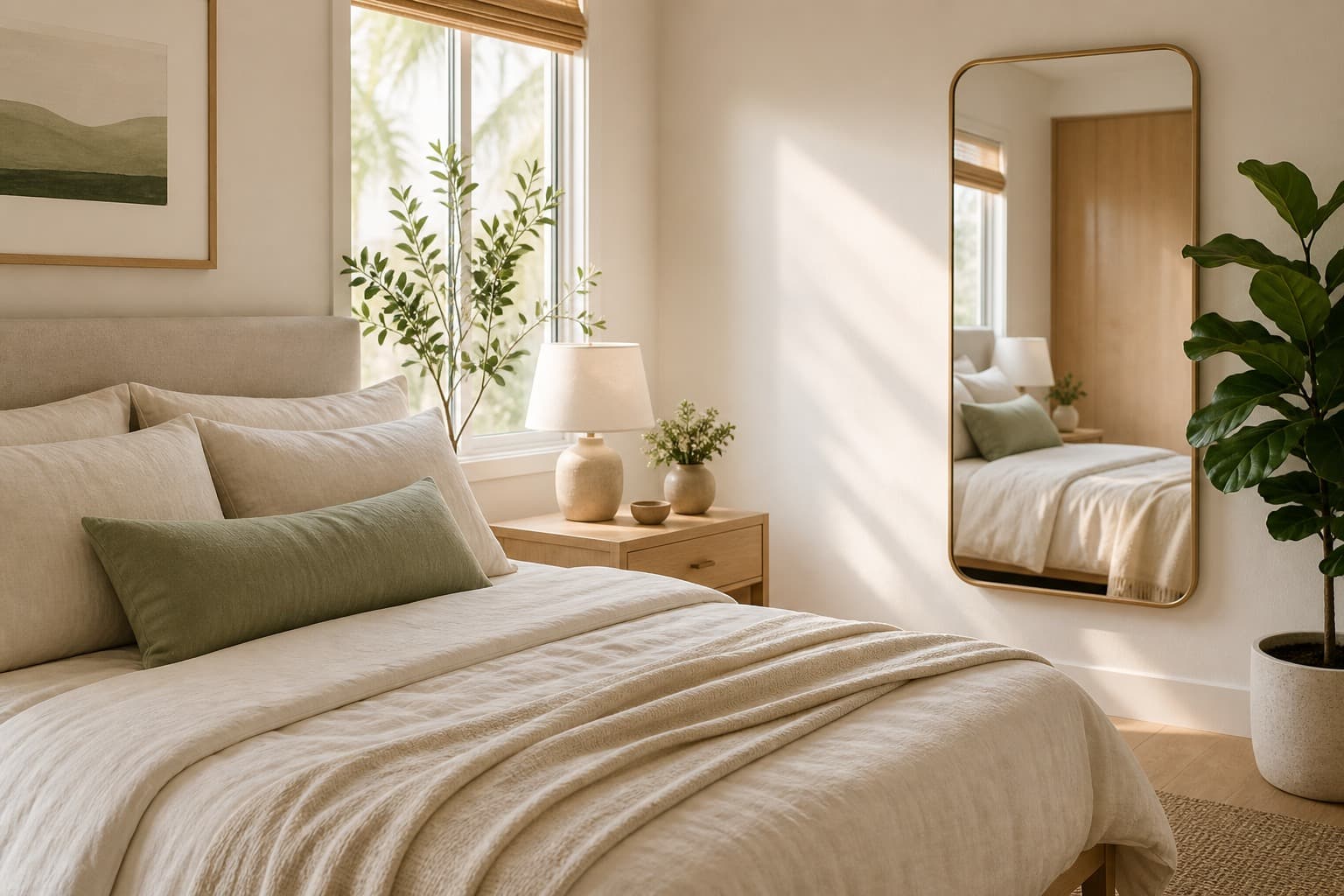
- 1Full-length mirror on the wall beside the bed
- 2The door, visible only in the reflection
- 3The bed, reflected back into the room
Why mirror placement matters more than people think
A feng shui mirror bedroom question sounds small, but mirror position is one of the most common layout issues in rentals, studio apartments, and shared rooms where furniture options are limited. In environmental psychology, mirrors function as secondary light and motion sources. They bounce visual information back into a room, which can quietly keep the eyes and brain more alert than a sleep space usually calls for.
This is not about a mirror having power over you. It is about how your nervous system reads a room while you are trying to relax. A mirror that catches hallway light, doorway movement, or your own silhouette at 2 a.m. can register as low-level stimulation, even if you never consciously notice it. The good news is that almost every mirror placement issue has a renter-friendly, fully reversible fix.
Feng Shui Mirror Placement Mistakes and Fixes
Mistake 1: The mirror faces the bed directly
When a mirror sits directly across from the bed, it doubles the visual field: the ceiling, the light fixtures, any movement, all reflected back at you. Sleep researchers link a busier visual environment to a slower wind-down process, since the eyes keep scanning even in dim light.
Fix: Angle the mirror slightly so it reflects a wall or closet instead of the mattress. If it is fixed or hangs on a shared wall, a folding screen, a woven throw, or a simple curtain rod with linen fabric can soften the reflection at night without any drilling or permanent change.
Mistake 2: The mirror directly faces the bedroom door
A mirror positioned to reflect the door back into the room can make the space feel like it has two entry points, which some space-psychology researchers connect to a subtle sense of being unsettled rather than settled, since the eye keeps returning to the doorway reflection.
Fix: Reposition the mirror along a side wall rather than the wall directly opposite the door. In small apartments where wall space is tight, a narrow full-length mirror on the inside of a closet door solves this instantly and stays completely renter-safe.
Mistake 3: A mirror hangs above or behind the headboard
Mirrors mounted above or behind the bed are common in older rentals and shared rooms, often left over from a previous tenant's setup. This placement means you cannot see the reflection while lying down, but it can still create a sense of visual weight above the sleeping area, similar to shelving or artwork that feels too heavy overhead.
Fix: Move the mirror to an adjacent wall, or replace it temporarily with a soft textile piece, like a woven wall hanging or fabric tapestry, that keeps the wall from feeling bare while removing the overhead reflection. For layout ideas that work with awkward headboard walls, the feng shui bed placement guide is a useful next read.
Mistake 4: No wall space, so the mirror ends up in an odd, unavoidable spot
In small apartments and shared rooms, sometimes there is genuinely only one wall available for a full-length mirror, and it happens to face the bed. This is one of the most common real-world constraints readers deal with, and it does not mean the room is a lost cause.
Fix: Use a lightweight, moveable option instead of a wall-mounted one, like a leaning floor mirror that can be turned toward the closet at night, or a door-mounted mirror on a door that stays closed while you sleep. Both solutions require zero wall damage and take seconds to adjust.
Mistake 5: A closet or wardrobe mirror catches your reflection at odd angles
Sliding wardrobe mirrors are common in apartments, and they can reflect the bed at an angle that is easy to miss during the day but noticeable at night when a hallway light or streetlamp catches the glass.
Fix: Keep the wardrobe doors closed at night, or apply a removable frosted window film to the lower half of the mirror. This is a fully reversible option that renters can peel off without leaving residue, and it still allows the mirror to function normally during the day.
How this guide differs from our mirror-facing-bed article
If you searched specifically for a mirror directly facing your bed, our dedicated mirror facing bed guide goes deeper into just that one scenario with more remedy detail. This guide is broader: it covers five different mirror placement issues, of which "facing the bed" is only one, including doorway reflections, headboard mirrors, and awkward closet mirrors. Use this one if you're not sure which specific placement issue you have, or if you want the full picture of mirror placement in a bedroom.
Fixes ranked by effort
| Fix | Effort | Best for |
|---|---|---|
| Angle a free-standing mirror away from the bed | Lowest | Any renter, no tools needed |
| Keep closet/wardrobe mirrors closed at night | Lowest | Sliding or hinged closet mirrors |
| Add a curtain or throw to cover at night | Low | Fixed wall mirrors you can't move |
| Apply removable frosted film | Medium | Built-in mirrored closet doors |
| Replace with a smaller, softer-framed mirror | Higher | If you're shopping for a new mirror anyway |
A modern rule of thumb
If you are unsure whether a mirror placement is an issue, try this simple test: lie in bed with the lights low and notice whether your eyes are drawn to the mirror before they settle. If they are, a small adjustment, not a full mirror removal, is usually enough. For a broader look at how bedroom layout connects to rest, see this guide to mirrors facing the bed and how small adjustments compare to full repositioning.
Bedroom layout also connects to your personal directional preferences. If you want to go a step further, mapping your supportive directions with a Kua number can help you decide where furniture, including mirrors, feels most settled for your specific space.
FAQ
Is it ever fine to keep a mirror facing the bed?
Yes. Many people sleep well with a mirror facing the bed and never notice any difference. This guide is about giving you options if you do notice restlessness or visual busyness, not a rule that must be followed by everyone.
What is the single easiest fix for renters?
Angling a free-standing or leaning mirror away from the bed is usually the simplest option, since it requires no wall damage and can be adjusted in seconds if you change your mind.
Does the size of the mirror matter?
Generally, smaller mirrors with softer frames reflect less light and movement than large, frameless wall mirrors, which is why many space-psychology-informed layouts favor modest mirror sizes in sleeping areas.
Can a mirror facing a window instead of the bed cause similar issues?
A mirror facing a window mainly reflects daylight and outdoor movement, which is usually less disruptive at night than a mirror facing the bed, though heavy curtains can help if early morning light feels too bright through the reflection.
Which mirror placement mistake is the most common?
A mirror directly facing the bed is by far the most frequently asked-about scenario, which is why it also has its own dedicated guide with more remedy detail if that's specifically your situation.
I have more than one mirror issue in my bedroom. Where do I start?
Start with whichever mirror you notice most often, usually the one closest to or most visible from the bed. Fixing the highest-visibility issue first tends to resolve most of the restlessness even before addressing smaller secondary mirrors in the room.
This article is intended as cultural appreciation and interior design inspiration for your bedroom, not a guarantee of sleep, health, or any other outcome. For a more personalized starting point, try the free Kua Number Calculator at /kua-calculator/ to explore directions that may support your space.
You might also like
Mirror Facing Bed? 5 Simple Feng Shui Remedies for Better Sleep
Modern Feng Shui remedies for a mirror facing the bed, explained through sleep, safety, and space psychology.
Feng Shui Bed Placement: The Complete Modern Guide
Learn feng shui bed placement through sleep science and space psychology, with renter-friendly tips for the command position, headboards, and more.
Feng Shui Bagua Map Explained (No Overwhelm)
Confused by the feng shui bagua map? Here's a simple, modern breakdown of the nine zones and how to apply them without redesigning your whole home.
Next step
Curious which wall directions actually support your rest? Try the free Kua Number Calculator to map your personal bedroom layout.
Try the free calculator